
Best Window Heat Pump Units Today
Brighter Picks guide
Best Window Heat Pump Units Today
As an Amazon Associate I earn from qualifying purchases.
Products in this guide

Check the model, seller and latest price on Amazon.
This post contains affiliate links. Purchases made through them may earn a commission at no extra cost to you.
How I researched
-
I compared current manufacturer specs and manuals to confirm which window units are true heat pumps (not just electric strip heat), their BTU ratings, smart features, and any low-temperature limits.
-
I prioritized models with broad US availability and strong reliability signals, then weighed installation method (standard window vs. “over-the-sill”), noise, and control options.
Top picks
1. GE AWGP12WWA — Best for most rooms (smart + efficient)
If you want a true window heat pump that’s easy to live with, this 11,000-BTU model hits the sweet spot: efficient inverter performance, Wi-Fi controls (SmartHQ app), and heating suited to medium rooms around 450–550 sq. ft. Standard double-hung window install with an included kit.

Pros
-
True heat-pump heating (not just resistance).
-
ENERGY STAR-level efficiency with inverter compressor.
-
App and voice control; schedules and geofencing.
-
Capable room coverage for most living rooms/bedrooms.
Cons
-
Heating output drops as outdoor temps fall.
-
Bulky chassis; easier with two people to install.
2. GE AWGP08WWF — Best for small rooms & bedrooms
This 8,000-BTU heat-pump window unit brings the same smart features to smaller spaces, ideal for bedrooms and home offices up to ~350 sq. ft. Quieter and lighter than bigger chassis, so it’s easier to handle.
Pros
-
Compact heat pump with Wi-Fi control.
-
Right-sized for small rooms; energy-sipping inverter.
-
Widely available at major retailers for quick pickup.
Cons
-
Lower heating BTUs—best as supplemental heat.
-
Not ideal for drafty rooms or high ceilings.
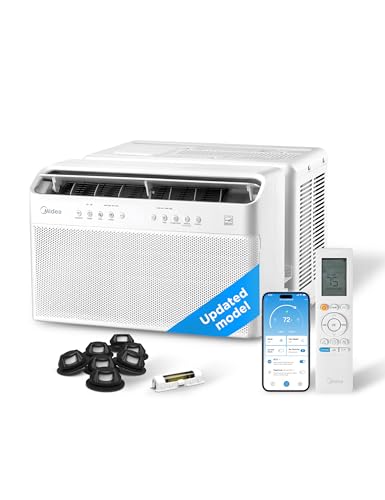
3. Midea MAW12H2ZWT (12,000 BTU) — Best value heat-pump combo
A budget-friendly way to get cooling + heat pump in one window unit, with app control, scheduling, and solid coverage up to ~500–550 sq. ft. Note the typical low-temp limit: heat-pump mode is for shoulder seasons, not deep winter. Check price on Amazon.

Pros
-
True heat-pump heating at an approachable price.
-
Smart controls with routines and timers.
-
Good capacity for medium rooms.
Cons
-
Heating performance tapers off near ~40°F outdoor temps.
-
Standard window-unit noise profile (not as quiet as premium picks).
Buying guide
-
Confirm it’s a heat pump. Many “heat & cool” window A/Cs use electric resistance strips. Look for explicit “heat pump” in the specs.
-
Match BTUs to room size. Roughly: 8k for ≤350 sq. ft., 10k–12k for ~400–550 sq. ft., higher for large/open spaces.
-
Cold-weather plan. Most window heat pumps lose capacity near freezing; if you see regular sub-freezing temps, choose a model with backup electric heat (often 230V) or consider a mini-split.
-
Noise & comfort. Inverter units ramp up and down instead of cycling on/off—usually quieter and more consistent.
-
Install constraints. Measure carefully. Saddle units need the right sill/wall geometry; standard units need sturdy brackets and a helper to lift.
-
Smart features. Wi-Fi apps (GE SmartHQ, Friedrich, Soleus, Midea) make scheduling and energy savings easier.
FAQs
Q: What’s the difference between a heat-pump window unit and a “heat & cool” window A/C?
A: A heat pump reverses the refrigeration cycle to move heat efficiently. Many “heat & cool” models rely on electric resistance heaters, which cost more to run. Always confirm “heat pump” in the listing.
Q: Will a window heat pump work in winter?
A: They shine in spring/fall and mild winters but lose capacity as temps drop. For reliable sub-freezing heat, go with a model that includes backup electric heat or a dedicated cold-climate mini-split.
Q: Are saddle/“over-the-sill” units worth it?
A: If your HOA dislikes traditional window units or you want more daylight and a safer install, yes—provided your sill width and wall thickness meet the spec.
Q: Do these work with Alexa/Google?
A: Most current models offer Wi-Fi control with app scheduling and typically support voice assistants; check the specific listing for compatibility.
Q: How loud are they?
A: Inverter models are generally quieter than fixed-speed units because they modulate instead of cycling. Expect a steady hum rather than abrupt on/off noise.