
Best kayak fish finder
Brighter Picks guide
Best kayak fish finder
As an Amazon Associate I earn from qualifying purchases.
Products in this guide

Check the model, seller and latest price on Amazon.
Kayak fish finders live or die by sunlight readability, easy mounting, and not killing your battery. I prioritized compact units with proven sonar modes (CHIRP + imaging), simple controls, and kayak-friendly power draw.
How I researched
I compared the last 12–24 months of current model lineups and spec sheets, prioritized screen size (inches) for on-water readability, checked sonar modes + GPS/mapping for typical kayak use, noted power draw for small batteries, and weighed long-term ownership (mounting, accessories, support).
Top picks
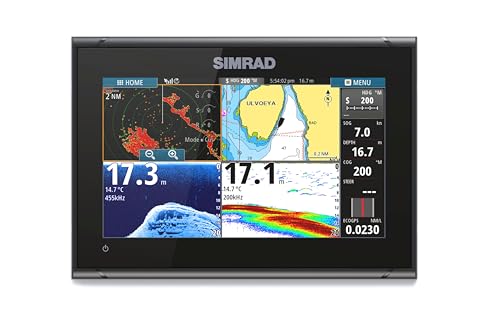
Simrad GO Chartplotter & Fish Finder (with transducer, preloaded C-MAP) — Best for a bigger, brighter screen + mapping
If I’m optimizing for “easy to see in full sun” and real chartplotting, this is the premium step up: a bright SolarMAX display, touchscreen operation, and preloaded C-MAP charts.
Why it wins: large high-brightness touchscreen + full C-MAP mapping + included transducer.
Pros
- Large, very bright SolarMAX HD touchscreen for full-sun readability
- Preloaded C-MAP charts plus CHIRP + DownScan sonar via the included transducer
- Chartplotter-grade GPS, routes, and waypoints
- Expandable (radar/engine options) if you upgrade your rig later
Cons
- Premium, boat-grade unit — pricier and larger than typical kayak finders
- Bigger head unit needs more deck space and a solid mount
- More capability (and menus) than a small-pond angler needs
Social proof: See reviews on Amazon.
Trade-offs / who should skip
- If you rarely use mapping and want simpler wiring, a smaller deck footprint, and a lower price, the PiranhaMAX or the compact Garmin below are easier fits. Choose the Simrad if you want the brightest, most capable screen here and don’t mind the size and cost.
Scores: Performance 5/5 • Screen size 5/5 • Ease of use 4/5 • Value 3/5
Garmin STRIKER Vivid 4cv (010-02550-00) — Best for most kayak anglers
A compact, easy-to-run unit that still gives you CHIRP + ClearVü-style detail and GPS basics for marking spots.
Why it wins: 4.3″ screen in a small footprint + CHIRP/clear scanning + waypoint GPS.

Pros
- 4.3″ QSVGA display (272×480) is kayak-readable
- CHIRP traditional + ClearVü scanning with included transducer
- IPX7 water rating; 12–20V input (typical kayak battery friendly)
- Vivid palettes can help separation at a glance
Cons
- 4.3″ can feel cramped for split screens
- No built-in lake charts (it’s not a full chartplotter)
Social proof: See reviews on Amazon.
Trade-offs / who should skip
- Skip if you want preloaded lake maps and more chart features—look at the Simrad GO above or the Lowrance Eagle pick below.
Scores: Performance 4/5 • Screen size 3/5 • Ease of use 4/5 • Value 4/5
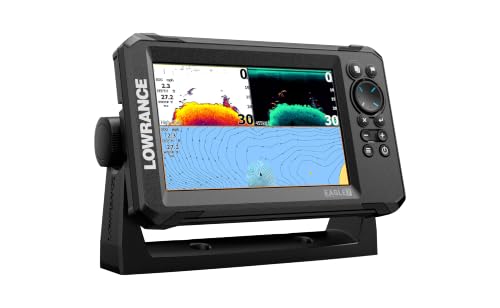
Lowrance Eagle (bright IPS, mapping + FishReveal sonar) — Best for GPS waypoints + stronger sonar power
This is my “serious upgrade” pick if you want a bright IPS screen with internal GPS, microSD mapping, and Lowrance’s FishReveal CHIRP + DownScan sonar in one unit.
Why it wins: bright IPS display + GPS/mapping + FishReveal CHIRP/DownScan sonar.
Pros
- Bright, high-contrast IPS display that holds up in daylight
- Internal GPS with waypoints, plus microSD for mapping
- FishReveal combines CHIRP + DownScan structure on one screen
- Modern successor to the HOOK Reveal line, with included transducer
Cons
- More features = more menu depth than simpler units
- Bigger head-unit footprint than 4-inch models
- Steps up in price over a basic budget finder
Social proof: See reviews on Amazon.
Trade-offs / who should skip
- If you fish tiny ponds and only need depth + basic structure, this can be overkill.
Scores: Performance 4.5/5 • Screen size 4/5 • Ease of use 4/5 • Value 3.5/5
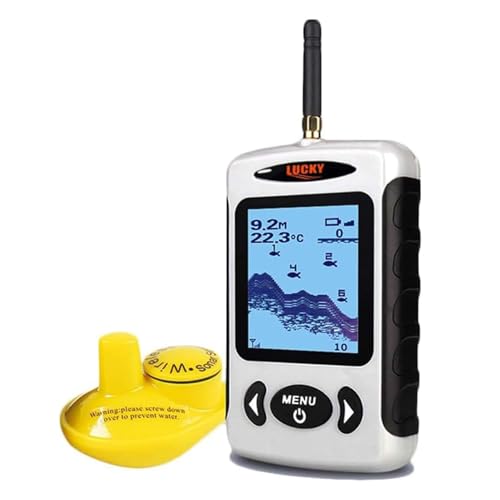
LUCKY FFW718 Wireless Castable Fish Finder — Best “no install” scouting (castable / trollable)
If you hate running cables through a kayak, a castable sonar is the cleanest setup — and unlike phone-based castables, this one comes with its own handheld color display, so you don’t have to babysit a phone in the sun.
Why it wins: no transducer wiring + wireless castable sensor + its own dedicated LCD (no phone required).
Pros
- Fully wireless — cast it out or troll it, no cables through the hull
- Comes with its own handheld color LCD; no phone/app needed
- Shows depth, fish, weeds, and bottom contour at a glance
- Inexpensive and backed by a large base of long-term reviews
Cons
- No GPS or chart mapping (it’s a scouting sonar, not a plotter)
- Small basic display and shorter wireless range than premium units
- Best for slow trolling or casting, not fast paddling
Social proof: See reviews on Amazon.
Trade-offs / who should skip
- Skip if you want GPS waypoints or glanceable, always-on chart data; this is a grab-and-go depth/fish scout, not a mapping unit.
Scores: Performance 3.5/5 • Screen size 2/5 • Ease of use 4/5 • Value 4/5
Humminbird PiranhaMAX 4 DI (410160-1) — Best simple Down Imaging on a tight budget
A straightforward “turn it on and fish” option with a 4.3″ screen and Down Imaging—no GPS chart features to worry about.
Why it wins: simple interface + DI detail + low power draw.

Pros
- 4.3″ display; 272H × 480V pixel matrix
- Dual Beam + Down Imaging sonar
- Very modest draw listed at 180 mA (helps small batteries)
- Includes transducer and mount kit
Cons
- No GPS/waypoints
- Lower resolution than 800×480 5-inch units
Social proof: See reviews on Amazon.
Trade-offs / who should skip
- If you routinely return to exact offshore spots, you’ll miss GPS marking—step up to the Lowrance Eagle, Simrad GO, or Garmin GPS model.
Scores: Performance 3/5 • Screen size 3/5 • Ease of use 5/5 • Value 5/5
Quick compare
- Best daylight readability + mapping: Simrad GO — large bright SolarMAX touchscreen, C-MAP charts, included transducer
- Best overall balance: Garmin STRIKER Vivid 4cv — compact 4.3″, CHIRP + ClearVü, GPS basics
- Best GPS + stronger sonar: Lowrance Eagle — bright IPS, GPS/mapping, FishReveal CHIRP/DownScan
- Best no-wiring setup: LUCKY FFW718 — wireless castable, its own handheld display, no phone needed
- Best simple budget unit: Humminbird PiranhaMAX 4 DI — 4.3″, DI, low draw
FAQs
What’s the easiest fish finder to mount on a kayak?
If “easy” means minimal wiring and no drilling, a castable/wireless sonar like the LUCKY FFW718 can be the simplest—there’s nothing to wire, and it comes with its own handheld display.
If you want a dedicated fixed screen, a compact gimbal-mount unit (like the 4.3″ class) usually fits tighter kayak cockpits more easily.
Do I really need GPS on a kayak fish finder?
No—but it’s the fastest way to build a “milk run” of repeat spots (humps, edges, brush piles). Units like the Lowrance Eagle and Simrad GO include internal GPS and mapping features.
How big of a battery do I need?
It depends on the unit’s draw and how long you fish. As a rough method: (amps) × (hours) = Ah, then add extra for cold weather and backlight. As reference points, PiranhaMAX lists 180 mA and compact fixed-mount units draw around 0.9–1A; the LUCKY castable runs off its own rechargeable wireless sensor and handheld unit rather than your kayak battery.
Is a 4-inch screen too small?
It can be fine if you keep to one primary view (like CHIRP or DI) and don’t rely on split screens. If you want split-screen often, a 5-inch (or larger) display is noticeably easier.
Will any of these handle splashes and rain?
Several of these carry IPX7 water ratings (incidental immersion resistance), including the Garmin Vivid manual specs and the Simrad GO spec sheet; the castable LUCKY sensor is designed to float and sit in the water by design.