
Best Handheld Sewing Machine (for quick fixes & on-the-go mending)
Brighter Picks guide
Best Handheld Sewing Machine (for quick fixes & on-the-go mending)
As an Amazon Associate I earn from qualifying purchases.
Products in this guide

Check the model, seller and latest price on Amazon.
Handheld “menders” are great for quick hems, curtain tacks, and small repairs when hauling out a full machine is overkill. What really matters: stitch type (single-thread chain vs. two-thread lockstitch), one-handed control over fabric feed, whether an AC adapter is supported, and honest expectations—these won’t replace a real sewing machine for thick fabrics or long seams.
How I researched
I compared 2025 manufacturer manuals and docs first, plus credible gear guides. I prioritized stitch durability (lockstitch vs. chain stitch), battery/adapter options, ergonomics, and fit by fabric type. I also checked availability and noted unclear specs (e.g., UL/ETL—couldn’t verify for most). I weighed stitch security, layer handling, setup ease, and ownership hassle.
Top picks
SINGER Stitch Sew Quick 2 (01664) — Best overall for secure stitches
One of the few handhelds with a true bottom bobbin for a more secure two-thread lockstitch—better for hems and seams that shouldn’t unravel.
Why it wins: Two-thread design + dual speeds and bobbin winding make it the most capable “grab-and-go” mender here.
Pros
-
Two-thread lockstitch holds better than chain
-
Dual speeds; simple bobbin winding
-
Uses 4×AA or optional 6V adapter
-
Compact for hemming curtains in place
Cons
-
Not ideal for thick denim or multilayer seams
-
Learning curve to balance upper/lower tension
Social proof
General sentiment favors its stitch security over single-thread models—see reviews on Amazon.
Trade-offs / Who should skip
If you only mend light fabrics and want the cheapest option, a single-thread unit may be fine. If you need long, durable seams on thick material, use a full-size machine.
Scores: Performance 4.5/5 · Stitch durability 5/5 · Ease of Use 4/5 · Value 4.5/5
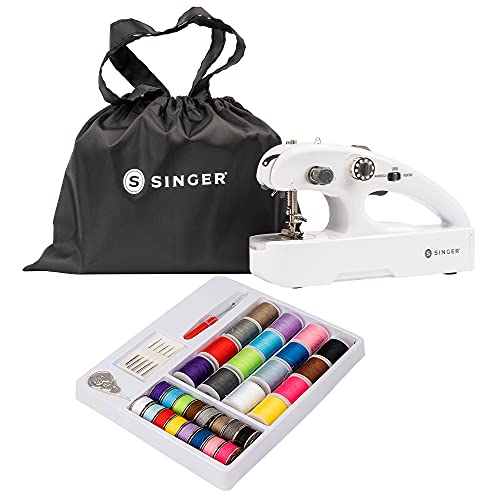
SINGER Stitch Quick+ (01774) — Best for tabletop and handheld use
Ergonomic handheld that can also run in desktop mode for steadier control, plus a bottom bobbin for two-thread stitching.
Why it wins: The only pick here that toggles Handheld/Desktop/Lock modes; easier for beginners to guide fabric.
Pros
-
Handheld or desktop modes; safer lock setting
-
Two-thread system with bottom bobbin
-
Optional 6V/1000mA adapter supported
-
Better control on long hems (desktop mode)
Cons
-
Bulkier than pure handhelds
-
Still “quick fixes”—not a full machine
Social proof
Positioned as a quick-fix tool—see rating & reviews on Amazon.
Trade-offs / Who should skip
If you want true one-hand spot-stitching only, Stitch Sew Quick 2 is lighter. Heavy fabrics? Use a standard machine.
Scores: Performance 4.5/5 · Stitch durability 5/5 · Ease of Use 4.5/5 · Value 4/5
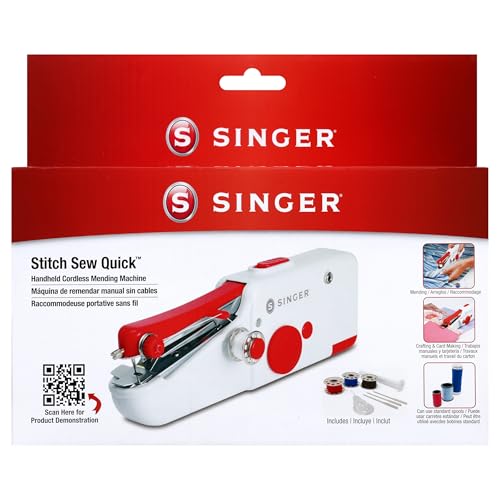
SINGER Stitch Sew Quick (01663) — Best budget for light, occasional repairs
Classic one-hand mender that uses a single-thread chain stitch—fine for quick tacks and temporary fixes.
Why it wins: Cheapest way to hem a sleeve or tack a curtain without taking it down.
Pros
-
Ultra-portable; fits a junk drawer
-
Faster than hand-sewing small tacks
-
Dead-simple threading path
Cons
-
Chain stitches can pull out if not secured
-
Works best on lighter fabrics only
Social proof
Plenty of user anecdotes for quick hems—see reviews on Amazon.
Trade-offs / Who should skip
If you want seams that won’t unravel under stress, the two-thread models above are better.
Scores: Performance 3.5/5 · Stitch durability 3/5 · Ease of Use 4/5 · Value 4/5
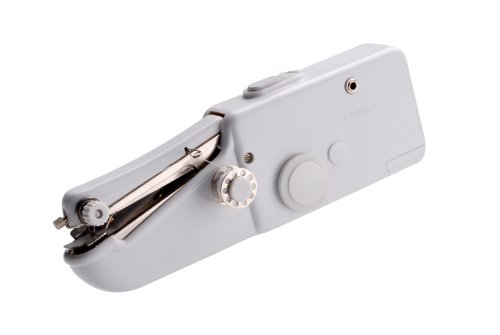
Tivax / Michley ZDML-2 — Best ultra-light travel backup
Tiny 0.6-lb handheld with single-thread chain stitch, 4×AA or 6V DC power, and pocketable dimensions—great for glove box or RV kits.
Why it wins: Verifiable size/weight/power and one of the lightest true handhelds around.

Pros
-
Very light (about 0.6 lb)
-
DC 6V adapter option; versatile power
-
Simple emergency repairs on trips
Cons
-
Single-thread; secure ends manually
-
Not ideal for thick fabrics
Social proof
Commonly used as a travel “just in case” tool—see reviews on Amazon.
Trade-offs / Who should skip
If you’ll hem pants regularly, pick a two-thread model.
Scores: Performance 3.5/5 · Stitch durability 3/5 · Ease of Use 4/5 · Value 4/5
Quick compare
-
Stitch Sew Quick 2 — Best overall: Two-thread lockstitch; dual speeds; adapter option. Not for heavy denim.
-
Stitch Quick+ — Best handheld/desktop: Mode switch boosts control; two-thread system; adapter ready. Slightly bulkier.
-
Stitch Sew Quick (01663) — Best budget: True handheld simplicity; chain stitch. Less durable seams.
-
Tivax/Michley ZDML-2 — Best travel: ~0.6-lb, tiny; DC option. Chain stitch only.
Buying guide
1) Lockstitch vs. chain stitch
If you want seams that won’t easily pull out, pick a two-thread lockstitch handheld (Stitch Sew Quick 2 or Stitch Quick+). Single-thread chain stitch units are fine for quick tacks but need knots/tape at the ends or the stitch can unravel.
2) Power & runtime
All of these run on 4×AA; some accept a 6V adapter (nice for tabletop use or longer sessions). Verify voltage and plug spec in the manual.
3) Fabric & thickness
Handhelds are for light to medium fabrics and short seams. Even the better models are quick-fix tools, not replacements for full machines on thick materials. Test on scraps first.
4) Ergonomics
Look for a comfortable grip and an ON/OFF button you can feather with your thumb; desktop mode (Quick+) helps keep lines straighter on longer hems.
5) What I couldn’t verify
UL/ETL listings weren’t clearly published for most handhelds. If that matters, consider a small full-size machine instead.
FAQs
Q: Can a handheld sew jeans or leather?
A: Not reliably. They’re intended for light fabrics and short runs; use a standard machine/needle for heavy materials.
Q: Why does my seam pull out?
A: Single-thread chain stitches can unravel if the tail is tugged. Tie off or tape the thread ends—or use a two-thread model for a lockstitch.
Q: Batteries or adapter?
A: AA batteries are convenient; adapters are great at a desk. Check the exact voltage/plug spec in your manual before buying one.