
5 Home Dehumidifiers for Damp Rooms and Musty Smells
As an Amazon Associate, we earn from qualifying purchases. Some links may earn us a commission at no extra cost to you.
A musty basement, damp bedroom, or humid laundry room can make a home uncomfortable even when everything looks clean. A good dehumidifier removes excess moisture from the air and helps maintain a more comfortable indoor humidity level. The right model depends on more than room size. Moisture-removal capacity, drainage options, tank size, noise, controls, and everyday convenience all matter.
The five dehumidifiers below cover a range of needs, from moderate bedroom humidity to persistent moisture problems in basements and laundry rooms.
Our Top Picks at a Glance
Midea 50-Pint Cube with Built-In Pump — Best for larger spaces and convenient automatic drainage.
Honeywell TPFIT50PWK 50-Pint — Best for basements and users who prefer straightforward controls.
Waykar 34-Pint Energy Star Dehumidifier — Best middle-ground option for moderate household humidity.
hOmeLabs 50-Pint Wi-Fi Dehumidifier with Pump — Best for smart controls and frequent operation.
HUMILABS 30-Pint Dehumidifier — Best for bedrooms, offices, and quieter occupied spaces.
1. Midea 50-Pint Cube with Built-In Pump
Best for: Larger spaces and low-maintenance drainage

The Midea Cube takes a different approach from the usual tall rectangular dehumidifier. Its lift-and-twist design allows the main unit to sit higher on the water tank during normal use, then nest down into a more compact cube for storage.
With a 50-pint daily capacity, it has enough moisture-removal power for larger areas such as basements, laundry rooms, garages, and open living spaces.
One of its biggest advantages is the built-in pump. Instead of relying only on gravity, collected water can be pumped upward toward a sink or another suitable drain.
The Cube also supports continuous drainage and includes smart controls for monitoring and adjusting humidity settings.
Why Choose It?
The Midea Cube combines high capacity, a large water tank, pump drainage, smart controls, and a space-saving storage design.
Its larger bucket can also reduce how often you need to empty it when automatic drainage is not being used.
Pros
- 50-pint daily capacity
- Built-in pump
- Continuous drainage
- Large water tank
- Smart controls
- Caster wheels
- Compact nesting design
Cons
- Heavier than smaller models
- More features than necessary for mild humidity
2. Honeywell TPFIT50PWK 50-Pint Dehumidifier
Best for: High-capacity moisture removal with straightforward controls

The Honeywell TPFIT50PWK uses a traditional upright design while providing strong 50-pint moisture-removal capacity.
It includes digital humidity controls, a washable filter, caster wheels, automatic operation, and several drainage options.
The built-in pump is particularly useful in a basement or laundry room when the nearest suitable drain is positioned higher than the dehumidifier.
Instead of repeatedly emptying the bucket, collected water can be pumped away automatically.
Its straightforward control panel may also appeal to users who want convenient automatic operation without relying heavily on smart-home features.
Why Choose It?
The Honeywell is a practical option if you want strong moisture removal, pump drainage, and a familiar upright design without making Wi-Fi controls a priority.
Pros
- 50-pint daily capacity
- Built-in pump
- Continuous drainage
- Digital humidity controls
- Washable filter
- Caster wheels
- Automatic operation
Cons
- Takes more floor space than compact models
- Built-in pump may be unnecessary if you already have a nearby floor drain
3. Waykar 34-Pint Energy Star Dehumidifier
Best for: Moderate humidity and medium-size spaces


The Waykar 34-Pint offers a useful middle ground between smaller household dehumidifiers and larger 50-pint machines.
Its compressor system removes up to 34 pints of moisture per day, while automatic humidity control allows the unit to maintain the selected humidity level without constant adjustment.
A continuous drain connection is included for longer operating periods, and automatic defrost helps keep the machine operating as room temperatures change.
The compact upright design, caster wheels, timer, and simple controls also make it easy to move between bedrooms, home offices, laundry areas, and other humid parts of the house.
Why Choose It?
The Waykar provides more moisture-removal capacity than smaller units without the size and weight of many 50-pint models.
It also includes the everyday features most households are likely to use, including automatic humidity control, continuous drainage, a timer, and caster wheels.
Pros
- 34-pint daily capacity
- Automatic humidity control
- Continuous drain option
- Automatic defrost
- 24-hour timer
- Caster wheels
- Compact upright design
Cons
- No built-in pump
- Smaller tank than some larger models
4. hOmeLabs 50-Pint Wi-Fi Dehumidifier with Pump
Best for: Smart controls and automatic drainage
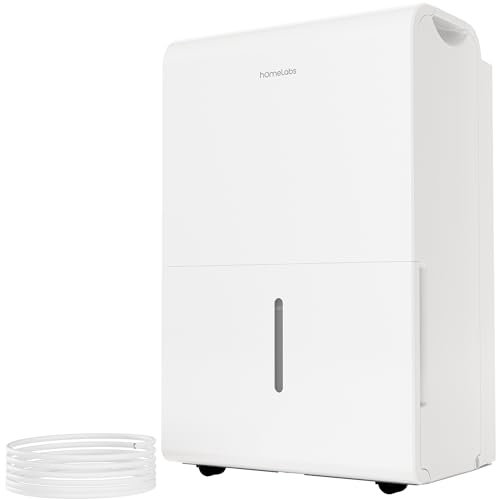
The hOmeLabs 50-Pint model combines high moisture-removal capacity with Wi-Fi controls and automatic pump drainage.
It removes up to 50 pints of moisture per day under standard operating conditions and allows humidity settings and operating modes to be adjusted remotely through its Wi-Fi connection.
The built-in pump is particularly useful when collected water needs to travel upward into a laundry sink or another suitable drainage point.
Automatic humidity controls can regulate the room without requiring frequent manual adjustments.
Why Choose It?
The combination of 50-pint capacity, Wi-Fi control, and pump drainage makes this model particularly convenient for a basement or another area where the dehumidifier may run regularly.
Pros
- 50-pint daily capacity
- Built-in pump
- Wi-Fi controls
- Continuous drainage
- Automatic humidity control
- Multiple operating modes
- Caster wheels
Cons
- More expensive than basic models
- Smart features may be unnecessary for simple setups
5. HUMILABS 30-Pint Dehumidifier
Best for: Bedrooms, offices, and moderately humid living spaces

The HUMILABS 30-Pint is a smaller option designed around quieter everyday operation.
Its capacity makes it a practical choice for bedrooms, home offices, apartments, bathrooms, and other moderately humid living areas.
The unit includes an LED humidity display, several operating modes, tank collection, and a continuous-drain connection.
Sleep mode reduces unnecessary lights and operating noise, which can make the unit easier to use near a bed or desk.
Why Choose It?
Not every humidity problem requires a large 50-pint machine.
The HUMILABS provides useful moisture removal in a more manageable size, with features better suited to occupied living areas.
Pros
- 30-pint daily capacity
- Quiet operation
- Sleep mode
- LED humidity display
- Continuous drainage
- Automatic shutoff
- Simple controls
Cons
- Lower capacity than larger models
- Slower in very humid spaces
How to Choose the Right Dehumidifier
Choosing a dehumidifier becomes easier when you focus on a few practical questions: How humid is the space? How much water does the machine need to remove? Where will the collected water go? And how much noise or maintenance are you willing to deal with?
1. Match Capacity to the Moisture Problem
The largest dehumidifier is not automatically the right choice.
A bedroom that becomes slightly humid during summer has very different needs from a basement that stays damp for months.
As a general comparison:
- 30 to 35 pints: Suitable for bedrooms, offices, apartments, and moderately humid areas.
- 50 pints: Better suited to basements, laundry rooms, garages, larger spaces, and areas where humidity remains high.
Pint-per-day capacity is often more useful than advertised square-foot coverage when comparing models.
2. Check the Actual Humidity Level
A small digital hygrometer can show how humid a room really is.
For many homes, roughly 40% to 50% relative humidity is a practical target.
A dehumidifier with an adjustable humidistat can monitor the room automatically and cycle around the selected setting instead of running unnecessarily.
3. Decide How the Water Will Drain
Every dehumidifier collects water. How you plan to remove that water can have a major effect on everyday convenience.
Water Tank
The simplest option is the machine’s internal bucket.
Once the tank fills, the dehumidifier stops until you empty it.
This can work well for occasional use but becomes less convenient when the machine removes large amounts of moisture each day.
Continuous Drain Hose
Many full-size dehumidifiers allow a hose to send collected water directly to a nearby drain.
The hose generally needs to run downhill so gravity can move the water.
This setup works particularly well when a basement already has a floor drain.
Built-In Pump
A built-in pump can move water upward rather than relying entirely on gravity.
This allows the machine to drain into a laundry sink or another suitable outlet located higher than the dehumidifier.
For regular basement use, a pump can significantly reduce routine maintenance.
4. Do Not Rely Only on Square-Foot Ratings
Dehumidifier listings often advertise very large coverage areas, but square footage does not tell the whole story.
Two rooms of the same size can have very different moisture-removal requirements depending on:
- Humidity level
- Temperature
- Ventilation
- How much outside moisture enters the space
For that reason, pint-per-day capacity can be a more useful comparison point.
5. Consider Tank Size
If you are not using continuous drainage, tank capacity becomes much more important.
A larger water tank means fewer trips to empty the dehumidifier.
This is especially useful with high-capacity machines, which can fill a small tank surprisingly quickly during humid weather.
6. Think About Noise
Compressor dehumidifiers contain both a compressor and a fan, so some operating noise is normal.
Noise tends to matter much more in a bedroom, office, or living area than in a basement or laundry room.
For occupied spaces, look for lower fan settings or a dedicated sleep mode.
7. Look for Wheels and Handles
Full-size dehumidifiers can be fairly heavy.
Caster wheels and built-in handles make it much easier to move the unit between a basement, laundry room, bedroom, or other part of the home.
Frequently Asked Questions
Will a dehumidifier help with a musty smell?
It can when excess humidity is contributing to the smell.
Lowering the moisture level can make a damp basement, bedroom, bathroom, or laundry area feel fresher and less clammy.
What humidity should a house be?
Around 40% to 50% relative humidity is a practical target for many homes.
Conditions vary by climate and season, so an adjustable humidistat can make it easier to maintain a comfortable level automatically.
Is a 30- or 35-pint dehumidifier enough?
It can be for moderate household humidity.
These capacities are well suited to bedrooms, offices, apartments, bathrooms, and smaller living areas.
A consistently damp basement or larger open space may benefit from a 50-pint model.
Is a 50-pint dehumidifier too large for a bedroom?
Not necessarily, but it may provide more capacity than the room needs.
Larger machines also occupy more space and may produce more noticeable fan noise.
For moderate bedroom humidity, a 30- to 35-pint model can be a more manageable option.
Is a built-in pump worth it?
It depends on where the collected water needs to go.
If a drain hose can run downhill into a nearby floor drain, gravity drainage is simple and effective.
If the nearest drain or sink is higher than the dehumidifier, a built-in pump can make continuous drainage much easier.
Can a dehumidifier run continuously?
Many household dehumidifiers support continuous operation.
Models with adjustable humidistats can automatically cycle the compressor on and off as the room reaches the selected humidity level.
Using a continuous drain hose or built-in pump can also eliminate the need to empty the water tank repeatedly.
Where should a dehumidifier be placed?
Place the machine where air can circulate freely around its intake and exhaust.
Avoid pushing it tightly against furniture or walls unless the manufacturer specifically allows that placement.
In a damp basement or laundry area, position the unit near the source of the humidity problem while leaving enough open space for proper airflow.
Final Verdict
The best choice depends primarily on the severity of the humidity problem and how you want to handle drainage.
Midea 50-Pint Cube: A strong option for high capacity, a large tank, smart controls, pump drainage, and compact storage.
Honeywell TPFIT50PWK: A good fit for users who want 50-pint capacity and pump drainage in a traditional upright design.
Waykar 34-Pint: A practical middle-ground choice for moderate humidity without stepping up to a larger 50-pint unit.
hOmeLabs 50-Pint Wi-Fi: Suited to households that prioritize remote controls and automatic pump drainage.
HUMILABS 30-Pint: A more manageable option for bedrooms, offices, apartments, and other occupied spaces with moderate humidity.
For most households, the decision ultimately comes down to three things: how humid the space gets, how much moisture needs to be removed, and how the collected water will be drained.
As an Amazon Associate, we earn from qualifying purchases. Some links may earn us a commission at no extra cost to you.
As an Amazon Associate, I earn from qualifying purchases.