
Best Portable AC Unit
As an Amazon Associate I earn from qualifying purchases. Some links may earn us a commission at no extra cost to you.
Portable ACs vary a lot, but one thing usually decides whether you’ll feel the difference: real cooling output (SACC/DOE BTU), not the bigger “ASHRAE” number on the box. I prioritized units that either (1) deliver higher SACC, or (2) stay quieter/more efficient while still cooling a normal bedroom or office.
How I researched
I compared manufacturer spec sheets plus reputable lab-style reviews where available, prioritized SACC/DOE BTU as the primary performance metric, checked hose design (single vs dual), noise info when published, dimensions/fit, and noted availability/EOL risk before picking the best all-around options.
Top picks
Midea Duo 14,000 BTU (12,000 SACC) — Best overall cooling for most rooms
If you want a portable AC that genuinely feels powerful, this is the one I’d start with because the SACC is unusually high for the category.
Why it wins: strong real-world cooling + inverter efficiency in a portable form factor.

Pros
- High 12,000 BTU SACC for faster, steadier cooling
- Inverter compressor (typically smoother temps, fewer harsh on/off swings)
- Compact-for-class footprint (check height/clearance)
Cons
- Heavier/bulkier than small-room units (plan placement)
- Window kit still matters; sloppy sealing hurts performance
Social proof: See reviews on Amazon.
Trade-offs / who should skip: If you can install a window unit, it’ll usually cool better per watt. If your window setup can’t accommodate the hoses well, you won’t get full benefit.
Scores: Performance 5/5 • SACC/DOE BTU 5/5 • Ease of Use 4/5 • Value 4/5
Whynter ARC-14S (9,500 SACC) — Best for traditional dual-hose performance + verified UL listing
Dual-hose designs generally waste less cooled air than single-hose units, and this one is a long-running “workhorse” choice with published airflow and dimensions.
Why it wins: dual-hose setup + strong airflow + long-standing popularity.

Pros
- 9,500 BTU SACC stated by the manufacturer
- Published airflow spec (useful if you care about circulation)
- UL listing is stated by the manufacturer
Cons
- Big/tall unit; measure your space first
- Dual hoses add setup clutter (worth it for performance)
Social proof: See reviews on Amazon.
Trade-offs / who should skip: If you need heating too, consider Whynter’s heat-capable sibling models instead of forcing this one.
Scores: Performance 4/5 • SACC/DOE BTU 4/5 • Ease of Use 3/5 • Value 4/5
LG LP1419IVSM (Dual Inverter, 10,000 SACC) — Best for quieter sleep + steadier temps
LG publishes a detailed spec set including low-mode noise levels, which is extremely helpful if you’ll run it overnight.
Why it wins: inverter comfort + clear noise specs.

Pros
- 10,000 BTU SACC listed by the manufacturer
- Low-mode sound level is published (good for sleep-focused setups)
- Published dimensions for fit planning
Cons
- Single-hose design can be less efficient in very hot climates
- Not the top pick for huge/open-plan areas
Social proof: See reviews on Amazon.
Trade-offs / who should skip: If your room is sun-blasted and truly large, you’ll likely be happier with a high-SACC dual-hose pick.
Scores: Performance 4/5 • SACC/DOE BTU 4/5 • Ease of Use 4/5 • Value 4/5
Hisense AP1022HW1GD — Best if you want dual-hose + heat mode
If you want one box for cooling in summer and heat in shoulder seasons, this model stands out because reputable reviewers identify it as dual-hose and cover its multi-mode performance.
Why it wins: versatility (cool/heat/dehumidify) + dual-hose approach.

Pros
- Dual-hose design (typically helps avoid negative-pressure issues)
- Has heating mode (useful for mild winters/shoulder months)
- App + voice assistant options if you care about that
Cons
- Heat performance varies by insulation (don’t expect “whole-house heat”)
- Model variants can be confusing—match the exact model label
Social proof: See reviews on Amazon.
Trade-offs / who should skip: If you only need cooling and want the most cooling per dollar, a non-heat model may be a better buy.
Scores: Performance 4/5 • SACC/DOE BTU 4/5 • Ease of Use 4/5 • Value 4/5
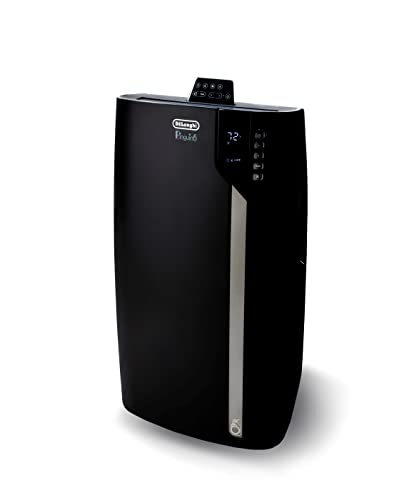
De’Longhi Pinguino PAC EX390LVYN (8,600 SACC) — Best for comfort features + humidity-aware control
This is a “comfort experience” pick—strong on temperature/humidity-aware control and how it feels near you, not just at the unit.
Why it wins: comfort-focused controls + published SACC.
Pros
- 8,600 BTU SACC published by the manufacturer
- Comfort features aimed at “where you are,” not just the unit location
- Solid option for humid rooms when paired with good sealing
Cons
- Lower SACC than the top cooling picks (expect slower pull-down)
- Bigger/heavier unit; check doorway + storage space
Social proof: See reviews on Amazon.
Trade-offs / who should skip: If your #1 goal is maximum cooling speed, the Midea/Whynter class is usually the better fit.
Scores: Performance 3/5 • SACC/DOE BTU 3/5 • Ease of Use 4/5 • Value 3/5
Quick compare
- Most cooling power (SACC): Midea Duo 14k (12,000 SACC)
- Best dual-hose “classic” pick: Whynter ARC-14S (9,500 SACC)
- Best for quieter sleep: LG LP1419IVSM
- Best for cooling + heating in one box: Hisense AP1022HW1GD
- Best comfort-feature focus: De’Longhi PAC EX390LVYN (8,600 SACC)
FAQs
Are portable AC units as good as window units?
Usually no—window units tend to cool more efficiently. Portable ACs win when a window unit isn’t possible (window type, renting rules, or you need room-to-room mobility).
What size portable AC do I need?
Use SACC/DOE BTU as your guide: ~8,000–10,000 SACC for many bedrooms; higher for hotter/larger spaces. If you’re between sizes, go up only if you can seal the window kit well.
Is dual-hose worth it?
Often yes, especially in hotter climates or leaky homes—dual-hose designs are typically less prone to the “negative pressure” problem than single-hose units.
As an Amazon Associate, I earn from qualifying purchases.