
Best Portable “Air Conditioners” without a hose (what actually works)
Brighter Picks guide
Best Portable “Air Conditioners” without a hose (what actually works)
As an Amazon Associate I earn from qualifying purchases.
Products in this guide

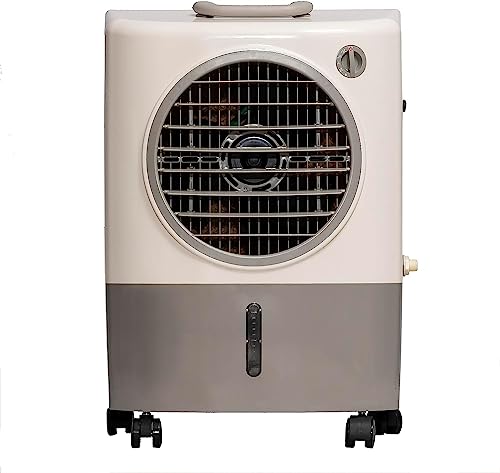
Check the model, seller and latest price on Amazon.
This post contains affiliate links. If you purchase them, we may earn a commission at no additional cost to you.
How I researched
-
I confirmed how evaporative coolers differ from real ACs, then looked at common dry-climate use cases.
-
I compared manufacturer spec sheets and retailer listings for airflow (CFM), coverage, tank size, wattage, and noise.
-
I prioritized models with reliable distribution, replaceable pads/filters, and recent owner feedback.
Top picks
1. Hessaire MC37M — Best for garages, patios & large spaces
If you want the strongest hose-free cooling you can roll around, the MC37M is the sweet spot: 3,100 CFM, coverage up to ~950 sq ft, and a 10.3-gal tank with hose hookup for continuous fill. It’s built for indoor/outdoor use and moves serious air.
Pros
-
Big airflow (3,100 CFM) for open rooms, shops, or patios
-
Large 10.3-gal tank + garden-hose connection = fewer refills
-
Simple controls; widely stocked with replacement pads
Cons
-
Large and loud compared with tower coolers; needs ventilation (doors/windows cracked)
-
Works best in dry climates; performance drops in humidity
2. Hessaire MC18M — Best budget pick for medium rooms & workshops
Compact but punchy at 1,300 CFM, ~500 sq ft coverage, 4.8-gal tank, and just ~82W draw. A good first evaporative cooler if you’re new to swamp coolers and want easy portability.
Pros
-
Strong airflow per dollar; light and easy to move
-
Low power consumption (~82W)
-
Widely available; replacement parts/pads are easy to source
Cons
-
Two fan speeds only; not as refined as pricier units
-
Not for humid climates (you’ll just make the room muggy)
Who should skip
-
Great for DIY spaces, garages, and dry climates. Skip if you need ultra-quiet sleep mode.
3. Evapolar evaCHILL — Best ultra-portable, personal cooler (desk/nightstand)
For solo cooling at a desk or bedside, evaCHILL runs off USB/power bank, claims up to ~9 hours per fill, and is explicitly marketed as cooling you (not a whole room). A realistic choice for renters, travel, and night-stand use.

Pros
-
Tiny, lightweight, and power-bank friendly
-
Simple one-button control with multiple fan speeds
-
Honest positioning: personal-area cooling only
Cons
-
Limited output—think “cool bubble,” not room cooling
-
Cartridge changes add ongoing cost
Who should skip -
Great if you only need your immediate space cooler. Skip if you expect it to drop room temps like AC.
Reality check: If you truly want refrigerated cooling with no hose, the only semi-viable option is a niche “personal AC” like Coolzy, which cools a micro-zone around you while dumping small amounts of warm air back into the room—so it won’t chill the room itself. Useful for focused comfort, not whole-room cooling.
4. Honeywell CS10XE — Best slim tower for small rooms
A bedroom/office-friendly evaporative cooler with ~300 CFM airflow, ~175 sq ft coverage, 2.6-gal tank, remote, and low ~102W draw—nice when floor space is tight.

Pros
-
Narrow footprint; easy to tuck beside a desk or bed
-
Low power consumption (~102W) with remote control
-
Broad parts/support footprint
Cons
-
Meant for personal/small room spot cooling, not whole-home
-
Will feel underpowered in very open spaces
Who should skip
-
Ideal if you need compact, light humidification + cooling in a dry climate. Skip if you expect refrigerated AC performance.
Buying guide
-
Dry vs. humid climates: Evaporative coolers shine in arid regions (Southwest/Intermountain West). In humid areas, they add moisture and feel less effective—consider a real portable AC (with hose) instead.
-
CFM & coverage: Match airflow (CFM) and the stated sq-ft rating to your space. Roughly: 300 CFM ≈ small room; 1,000–1,500 CFM ≈ medium; 2,500+ CFM ≈ large/open or outdoor use.
-
Tank size & refills: Bigger tanks (10–14 gal) or a garden-hose hookup mean hours of hands-off cooling—handy for patios/shops.
-
Power draw & noise: Many coolers sip power (often <250W) but can be noisy at high CFM. Check wattage/dBA in the specs and plan placement.
-
Indoor/outdoor rating: Large wheeled units are great under covered patios and garages; slim towers fit bedrooms/offices.
-
Expectation setting: Evap coolers do not lower indoor air temperature like refrigerant AC—especially in humidity. Crack a window/door for airflow.
FAQs
Q: Do real portable ACs exist without a hose?
A: No. Refrigerant-based portable ACs must vent heat outside; otherwise you’re just moving heat around. “Hoseless ACs” are evaporative coolers, which work differently.
Q: Will a swamp cooler work where I live?
A: Best in the dry West/Southwest. In sticky climates, performance drops and humidity rises.
Q: How big a cooler do I need?
A: Match CFM and coverage to the space (e.g., ~300 CFM for a small room; 1,000–3,000+ CFM for larger/open areas). Always check the model’s spec sheet.
Q: Do I need to open a window?
A: Yes—evaporative coolers need fresh air exchange to work well. Keep a window/door cracked so humid air can exit and fresh air can enter.
Q: Can I add ice for extra cooling?
A: Some users do; the effect is brief. Airflow (CFM), pad quality, and dry air matter far more than a handful of ice. Check your manual for guidance.